

January 7, 2026
Modernizing airline payments with crypto
How airlines can tap into a multi-million dollar opportunity
Global airline payments have evolved dramatically over the past few decades–from cash and paper tickets in the 1970s, to the rise of credit cards in the 1980s, online booking in the 1990s, and mobile wallets more recently. Each shift introduced greater convenience, but the underlying rails powering international commerce have barely changed.
Despite technological progress at checkout, airlines still rely on legacy payment systems that are slow, expensive, and fragmented across borders. With high volumes of international passengers, FX-heavy transactions, and elevated fraud exposure, airlines feel these constraints more than most industries.
Now, the sector is entering its next major evolution: blockchain-based payments. This includes the broader adoption of cryptocurrencies as a payment method, as well as stablecoins–digital tokens pegged 1:1 to fiat currency (typically USD) that provide predictable settlement value.
This isn't about crypto hype or the latest financial trends. This is about a practical, superior payment technology that Payment Service Providers (PSPs), global merchants, and modern enterprises are already implementing to optimize their most critical payment flows.
For any airline focused on margin retention, operational efficiency, and global reach, enabling crypto payments isn't optional anymore–it's strategic.
The scale of opportunity
According to Andreessen Horowitz's (a16z) State of Crypto 2025 report, the cryptocurrency industry has crossed a critical threshold. The total crypto market capitalization has surpassed $4 trillion for the first time, and there are now an estimated 716 million cryptocurrency owners globally. But the real story isn't just about ownership, it's about active usage.
While 716 million people own crypto, there are approximately 40-70 million active monthly users on blockchain networks, representing a 10 million increase from 2024. This gap between ownership and active usage represents a massive opportunity: as more holders convert to active users, the merchant ecosystem serving them becomes increasingly valuable.
TRM Labs reports a 125+ percent increase in retail transactions between January-September 2024 and the same period in 2025, showing rapid acceleration in retail-led adoption. This growth is driven by practical use cases such as payments, remittances, and preserving value in volatile economic conditions.
This growth is underpinned by major advances in blockchain infrastructure. Over the past five years, aggregate transaction throughput across major networks has grown more than 100x–from fewer than 25 transactions per second to 3,400 transactions per second. This level of infrastructure maturity now enables blockchain networks to reliably support large-scale growth and enterprise-grade payment systems.
- $4+ trillion crypto market cap
- 716 million crypto owners globally
- 40-70 million active monthly users, up 10 million from 2024
- 125%+ increase in retail crypto transactions year-over-year
- 100x increase in blockchain throughput over 5 years
Institutional momentum in travel
The a16z State of Crypto report describes 2025 as "the year the world came on-chain," and the institutional momentum backs that up. Major players across travel and aviation aren't waiting on the sidelines anymore–they're actively deploying crypto infrastructure:
- Emirates Airlines signed an MoU with Crypto.com to integrate crypto payments for flights and services, aligning the major global carrier with digital asset payment rails.
- Air Arabia became the first MENA airline to accept the AE Coin, an official UAE Dirham-backed stablecoin, for direct flight bookings on its website.
- Etihad Airways announced future plans (as of September 2025) to accept payments, including Bitcoin and other cryptocurrencies.
- Alternative Airlines and other major travel aggregators have recently expanded their stablecoin acceptance, enabling customers to pay for flights on over 600 global airlines using assets like USDT and USDC.
This institutional adoption signals a clear market opportunity for forward-thinking carriers.
The regulatory turning point
For years, regulatory uncertainty has been cited as a barrier to crypto adoption. 2025 changed that completely. Both the United States and European Union enacted comprehensive frameworks, creating clear rules that eliminate ambiguity and provide institutional confidence.
In the EU, MiCA regulations came fully into effect at the end of 2024, setting clear requirements for reserve backing, e-money licenses, and transparency for stablecoins and other crypto assets. Now only compliant stablecoins such as USDC and EURC are available on European exchanges.
In the U.S., meanwhile, the GENIUS Act became law on July 18 2025, with strong bipartisan support (68-30 Senate; 308-122 House). The law, which is the first major federal crypto legislation in U.S. history, requires 1:1 reserve backing, monthly audits, and priority claims for holders in insolvency, while clarifying that compliant stablecoins are neither securities nor commodities.
Both frameworks converge on key principles - reserve backing, consumer protections, and legal certainty - transforming crypto and stablecoins into fully regulated financial instruments. For merchants and institutions, this clarity removes a critical barrier, paving the way for widespread enterprise adoption.
The economics of crypto-enabled payments
The value proposition for accepting cryptocurrency extends far beyond tapping into a new customer segment of over 700 million crypto users. The economics and operational benefits are substantial:
Lower processing costs
Airlines pay significant card processing fees typically ranging 2-3.5% per transaction on ticket sales, upgrades, ancillaries, and loyalty purchases, eroding already thin margins in the competitive airline sector.
By settling directly on blockchain rails, airlines can reduce payment costs to a fraction of traditional card processing fees (typically 0.5-1.5%). Crypto payments eliminate intermediaries, interchange fees, and FX fees, allowing airlines to retain more revenue from every transaction. Fixed low costs apply regardless of transaction size, making even small ancillary purchases economically efficient.
Eliminate FX exposure and currency risk
Currency fluctuations between booking and settlement erode revenue on international transactions. A ticket booked in euros but settled days later in dollars exposes airlines to exchange rate risk, with foreign travelers often paying additional FX conversion fees of 1-3%.
Crypto acceptance - particularly through stablecoins - allows airlines to accept payments, issue refunds, or move funds globally with the speed of blockchain and the predictability of cash. Value remains stable end-to-end: no price swings, no mark-to-market adjustments, and no settlement uncertainty.
Solutions like Mesh allow airlines to settle in stablecoins or fiat, removing volatility from crypto payments and ensuring predictable, reliable settlement.
Zero chargebacks
Airlines are frequent targets of friendly fraud. Chargeback ratios for travel can reach 0.5-1%, which at scale could mean tens of millions in annual exposure, not including the operational costs of disputes.
Blockchain transactions are final and irreversible, like cash. This is a crucial advantage against card networks, which lose businesses billions annually to chargeback fraud. For sectors prone to high chargeback rates like travel services, this benefit alone can transform profitability by eliminating both direct losses and the operational resources dedicated to dispute management.
Settlement in seconds
Funds from card payments often take 2-5 business days to settle, locking up working capital. For airlines processing billions in revenue, settlement delays mean hundreds of millions in float tied up daily, reducing cash flow flexibility.
Crypto payments, in contrast, settle in seconds and operate 24/7/365 with no reliance on banking hours or holidays. This always-on infrastructure enables real-time cash flow and faster access to working capital across markets.
Near-perfect success rate
International card payments frequently fail due to fraud flags, spending limits, geo-restrictions, or routing issues, creating abandoned bookings and lost revenue from high-value international customers.
Blockchain-based payments bypass these intermediaries, achieving near-perfect success rates and smoother transactions for users.
Expanded market access
Crypto payments are open to anyone with internet access and a digital wallet, making it especially powerful in regions where traditional banking is costly, slow, or non-existent. For airlines, this unlocks access to a growing segment of high-value crypto travelers–particularly in markets with volatile local currencies such as Brazil, Nigeria, and Turkey.
Infrastructure reliability
Traditional payment processors can experience degraded service during traffic spikes, seasonal surges, or crisis-driven booking changes, leading to failed transactions during critical revenue periods.
Blockchain-based payment rails maintain consistent performance regardless of transaction volume, providing operational resilience when reliability matters most.
Example of impact for a major airline
Let's assume just 5% of a large international carrier's annual ticket revenue (€3.5 billion) is processed through crypto rails:
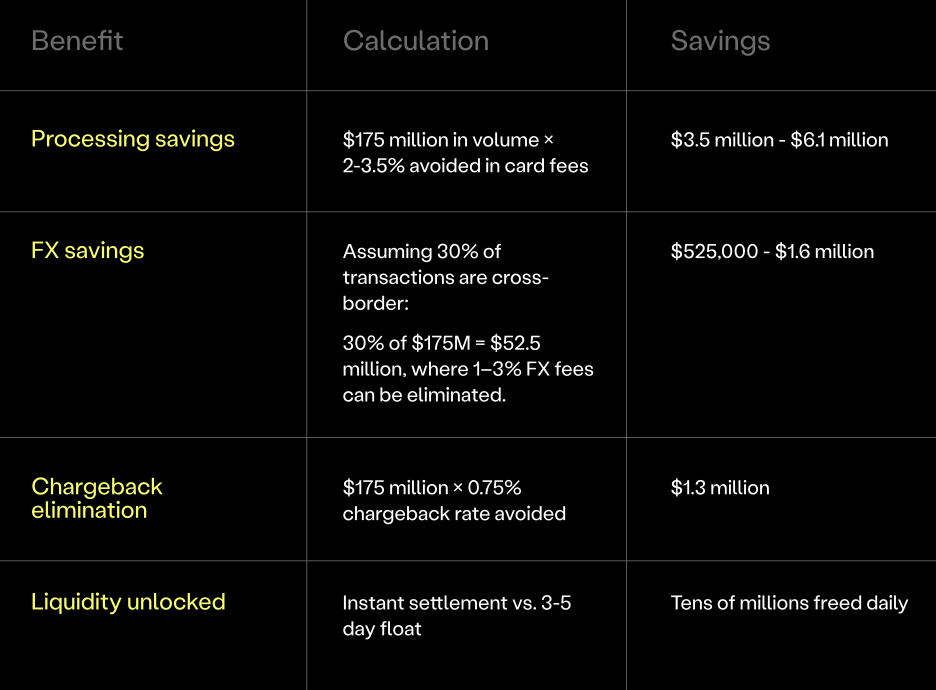
Overall, the financial impact amounts to around $5.3–$9 million in annual savings, excluding the new revenue potential from crypto-native travelers, higher international conversion rates, and lower operational costs from fewer disputes.
Blockchain-enabled use cases beyond crypto acceptance
While accepting crypto payments for tickets is the most immediate opportunity, blockchain technology enables a broader reimagining of how value flows across airline ecosystems. Rewards and loyalty programs can be tokenized, creating tradable, interoperable points that carry real value and work across partner networks. Customers gain true ownership of their points, while airlines reduce redemption liability, boost engagement, and increase transparency in reward distribution.
Vendor payouts and B2B settlements are another natural application. Airlines work with hotels, ground services, interline partners, aircraft leasing firms, and maintenance providers worldwide. Blockchain rails enable near-instant, low-cost settlement with these partners, eliminating the delays and fees of traditional international wire transfers.
The same infrastructure that enables seamless crypto ticket payments creates the foundation for these expanded applications, positioning forward-thinking airlines to unlock operational efficiencies, reduce costs, and innovate as blockchain adoption grows.
The bottom line
The travel sector is a natural fit for crypto adoption: airlines process massive cross-border volumes, navigate constant FX exposure across dozens of currencies, and depend heavily on expensive card rails. These are precisely the inefficiencies that blockchain payments are built to solve.
As the most significant innovation in payment infrastructure in decades, crypto payments present airlines with clear, immediate benefits:
- Lower costs: Cut processing and FX fees by up to 50%, saving millions on tickets, upgrades, and ancillaries.
- Instant settlement: Unlock billions in ticket revenue that would otherwise sit in multi-day windows.
- Reduced fraud: Save millions in avoided chargebacks by using final, irreversible transactions.
- Higher conversion: Eliminate FX friction, blocked cards, and international payment failures to boost bookings.
- Global reach: Expand revenue by reaching travelers in new and emerging markets.
As the ecosystem has matured, so too has the supporting infrastructure. Mature infrastructure providers like Mesh give major global payment service providers, including PayPal and Shift4, the tools to enable crypto payments at scale for their merchants–without having to build from scratch. Businesses can focus on core operations while Mesh ensures secure, reliable payments with volatility removed via stablecoin or local-currency settlement.
About Mesh: Mesh delivers enterprise-scale crypto payment infrastructure that makes accepting digital assets simple, secure, and fast. Businesses can settle instantly in stablecoins or local currency, removing volatility from the payment flow. Learn more at https://www.meshpay.com/use-cases/travel.


.png)

%20(1).png)






.png)
.png)
.png)
.png)
.png)
.png)
.png)
.png)

%20(1920%20%C3%97%201080%20px)%20(61).png)
.png)


.png)

%2520Wallet.png)


.png)
.png)


.png)


.png)
.png)


