Verify ownership of wallets and exchange accounts - securely and at scale.

.png)

.png)
Ensure compliance across exchange and wallet transfers. Verify users up front to reduce fraud, minimize risk, and maintain full control.
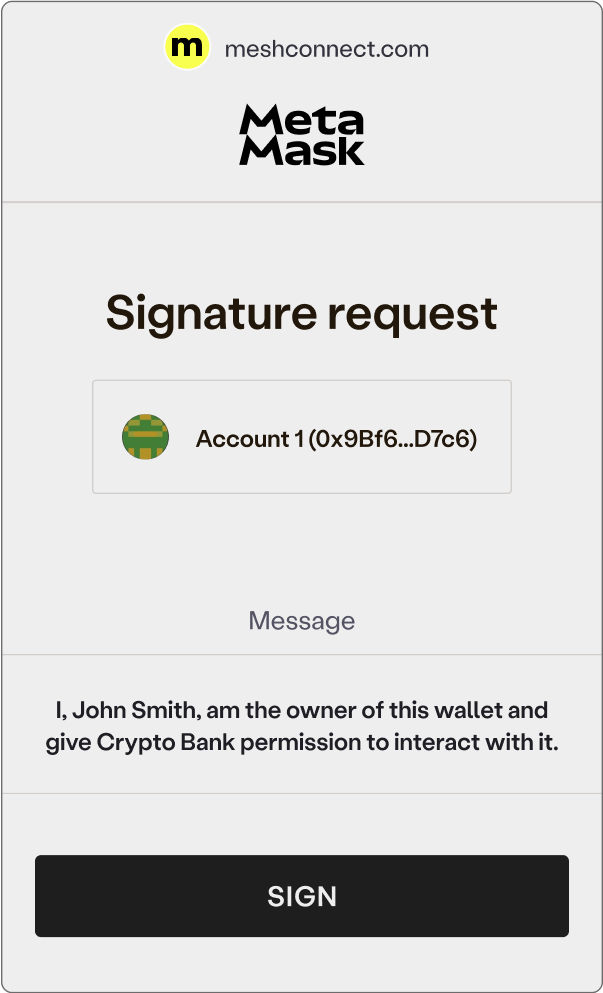
Enable users to certify wallet ownership through a signed and MiCA-compliant digital message.
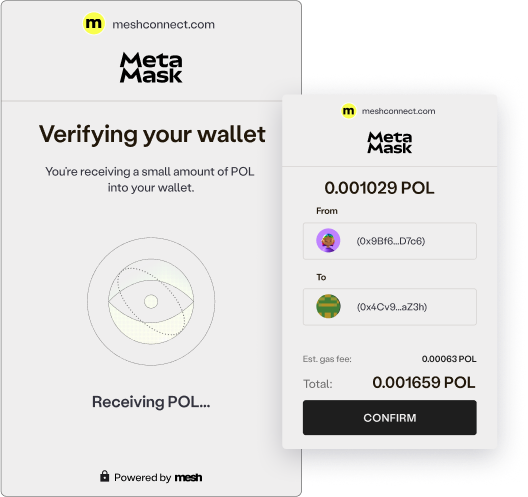
Mesh enables users to verify wallet ownership with a free to them micro-deposit - instant proof with no setup or fees.
.png)
Utilize Mesh's direct integrations with exchanges to seamlessly match and verify KYC-lite information on your platform.

Mesh integrates seamlessly with your existing compliance stack. Detect fraud, prevent risky transfers, and meet MiCA requirements in real time.
When wallet ownership isn't confirmed before a transaction lands, your platform absorbs the cost — in compliance exposure, frozen funds, and manual remediation.
Without pre-deposit verification, you cannot confirm who controls the wallet sending funds to your platform — creating AML exposure and provenance gaps before assets arrive.
Post-deposit discovery that an address is unverified forces a choice between freezing funds, manual investigation, or accepting regulatory risk. All three are expensive.
Frozen funds trigger customer complaints, compliance reviews, and manual workflows. The cost of fixing verification failures after the fact far exceeds preventing them upfront.
Verification sits between your existing KYC and your allowlist, turning identity into proof of asset control.
Your onboarding confirms who the customer is — documents, sanctions screening, identity checks. Mesh sits downstream of your existing stack.
Cryptographic message signing creates mathematical proof of wallet control before assets move. Gasless, off-chain, completes in under 30 seconds.
Mesh validates that the wallet supports the right network and token before the transaction executes — eliminating address and network mismatch errors.
KYC'd identity linked to verified wallet. Immutable audit trail. Future transactions from that address process without re-verification.
Verification adapts to the wallet, the chain, and your platform's policy.
The user signs a unique message with their wallet's private key. Mesh validates the signature against the wallet address, producing mathematical proof of control without ever exposing the key. No on-chain transaction, no gas fees.
For transfers from custodial exchange accounts, Mesh retrieves verified identity data from the source exchange so you can match it against your customer record.
When a user can't complete verification, you decide what happens. Block the transaction, route to manual review, or apply risk-based exceptions for lower-value transfers — thresholds and responses defined entirely by your compliance team.
The European Banking Authority cites cryptographic proof of control — specifically message signing — as an acceptable method for establishing self-hosted wallet ownership under Travel Rule guidelines. Every Mesh verification produces a record meeting this standard.
The EU Transfer of Funds Regulation applies the Travel Rule to all crypto transactions, regardless of value. The FATF Recommendation 16 framework underpins equivalent requirements in jurisdictions worldwide.
The verification method is jurisdiction-agnostic — implementation scope, risk thresholds, and fallback flows configurable to your regulatory environment.
Mesh provides verification infrastructure. Your platform retains policy, controls, and reporting authority.
From compliance teams, product leads, and integration engineers.
The user signs a unique, time-bound message with their wallet's private key inside their own wallet application. Mesh receives the signed message and validates it cryptographically against the wallet's public address. The private key never leaves the wallet and is never transmitted, stored, or exposed at any point in the flow.
Yes. The European Banking Authority explicitly cites cryptographic proof of control — message signing — as an acceptable method for establishing self-hosted wallet ownership under Travel Rule requirements. Every Mesh verification produces a record meeting this standard, including wallet address, signed message, cryptographic hash, and timestamp.
No. Mesh provides verification infrastructure only. Custody, transaction execution, and fund movement remain entirely within your existing systems. Mesh never holds, routes, or touches customer funds.
Fallback flows are fully configurable. Options include blocking the transaction until verified, routing to manual review via your support team, or applying risk-based exceptions for lower-value transactions per your policy framework. Your compliance team defines the thresholds and responses.
Verification data — wallet address, signed message, cryptographic hash, and timestamp — is returned to your platform in real time for storage within your own compliance infrastructure. Retention period and storage location are governed by your own policies, so the record stays under your control for regulatory reporting and audit.
Yes. The cryptographic verification method is jurisdiction-agnostic. While MiCA and EBA guidance are referenced as frameworks, Mesh supports institutions operating under FinCEN, FCA, VARA, MAS, SFC, and other regimes. Implementation scope, risk thresholds, and fallback flows are defined by your compliance team to match your regulatory environment.
Most platforms go live in under two weeks. Mesh provides a single API integration, a staged rollout framework, sandbox-to-production technical support, and dedicated compliance documentation for your audit and regulatory teams.
Mesh supports 300+ wallets and exchanges across 24 blockchain networks — covering self-hosted wallets and the major centralized exchanges your users transact with.