Blog
/

What it takes to make Mesh work at scale

Making Mesh work at scale

What it takes to make Mesh work at scale

The following is by Mesh Frontend Engineer, Balraj A


Building a payments system is hard. Building one that works across 300+ platforms is harder. At that scale, you’re no longer just integrating APIs–you’re designing a system that can survive inconsistency, failure, and constant change.

That was the challenge we faced at Mesh. What started as a series of integrations quickly became something else: a coordination problem across hundreds of systems that were never designed to work together.

In this article, I explain how we approached that problem and what it took to make Mesh work at scale.

The Problem: There’s no “standard” in payments

On paper, integrations sound simple: You connect to a platform and then move money from A to B. In reality, every platform is its own universe with different authentication models, asset representations, failure modes, compliance requirements, and latency and reliability characteristics.

Consider something as simple as a “balance”, which across platforms can mean:

  • Available balance
  • Settled balance
  • Spendable balance (after holds, fees, etc.)

Now multiply this complexity across 300+ platforms and the question becomes obvious: how do you create a system that stays consistent on top of inherently inconsistent foundations?

That was Mesh’s big challenge, and to solve it we approached the problem methodically, breaking it down into five key steps.

Step 1: Standardize everything

Every platform must be translated into a common internal model.

We standardized:

  • Assets: unified representation across crypto and fiat
  • Accounts: consistent structure regardless of provider
  • Transactions: every lifecycle is pending → processing → settled → failed
  • Errors: consistent categorization across all platforms

Without this standardization, logic becomes platform-specific, edge cases explode, and (most importantly) scaling becomes impossible.

Step 2: Build an orchestration layer

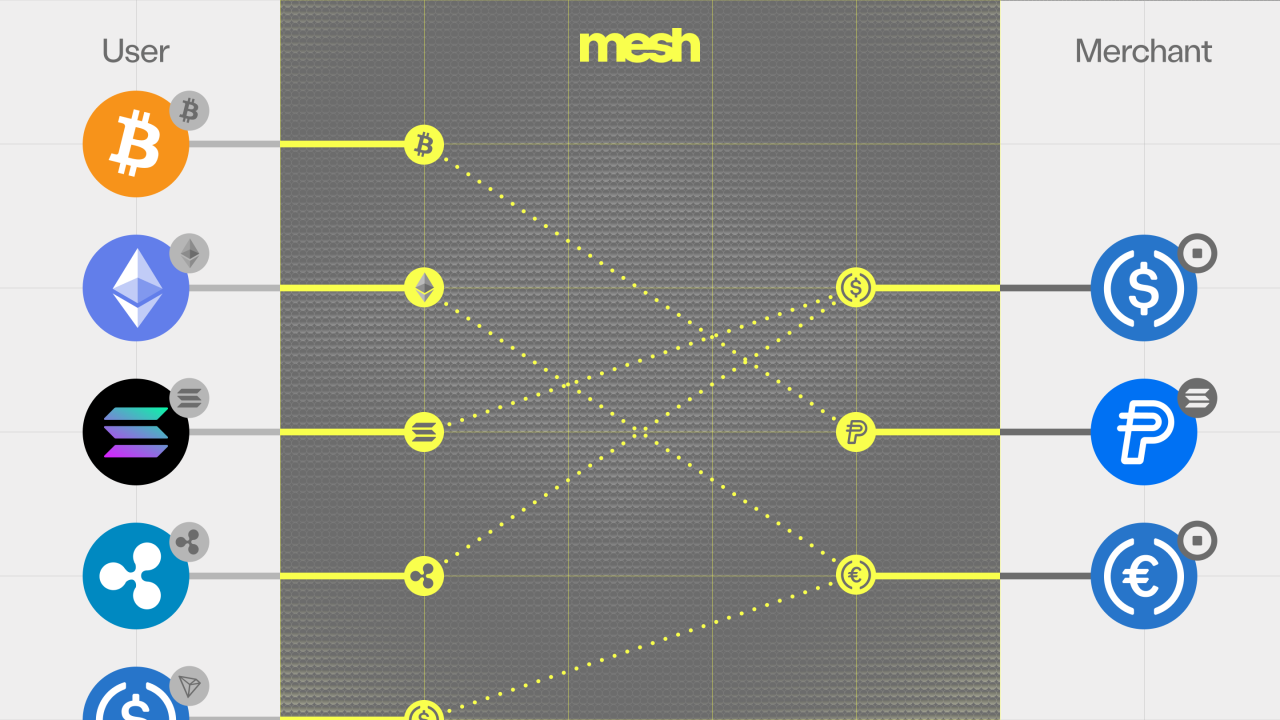
Once inputs are standardized, you can start making decisions. Instead of “Send payment via platform X,” the system can determine the best way to move value from A to B.

This introduces:

  • Routing logic: which rail to use
  • Fallbacks: what happens if things fail
  • Optimization: fees, speed, reliability

The orchestration layer is what turns integrations into infrastructure. Without it, you’re just connecting systems, but with it you’re coordinating them.

Step 3: Design for failure

Most systems assume success, but at a certain scale failure is the default:

  • APIs timeout
  • Webhooks arrive late (or never)
  • Balances drift
  • Transactions get stuck

Instead of asking “How do we make this work?” we asked “How do we make this recoverable?”

That meant designing the system so failures were expected, not exceptional. Operations could be retried safely, state could always be reconciled, processes reacted to events rather than requests, and no single error could disrupt the overall flow.

Step 4: Abstract complexity for the user

While the system is complex internally, it must be simple on the outside or the user will drop off.

Users don’t care which chain was used, which provider processed the transaction, or how many steps it took. They just want their payment to go from A to B.

To abstract complexity, the product layer focuses on three things:

  1. Deterministic UX: users always see a predictable, clear experience
  2. Clear states: users know what’s happening even if the underlying system is messy
  3. Fast feedback loops: users get immediate updates, even if final settlement takes longer

This is the point where engineering and product really come together: the goal is to make a complex system feel effortless for the user.

Step 5: Accept the system is never “done”

With 300+ platforms, change is constant. APIs evolve, new assets are added, and regulations shift. The system must be designed to handle this flux. It must be:

  • Modular: integrations can be swapped
  • Extensible: new platforms don’t break existing logic
  • Observable: you know what’s breaking, where, and why

Of all the steps, this one is the hardest. It’s relatively easy to build a system–the challenge is keeping it stable while the world around it keeps changing.

Closing thoughts

At small scale, payments are about moving money. At large scale, they’re about managing uncertainty. The role of infrastructure is to absorb that unpredictability and turn it into something reliable, consistent, and intuitive to the end user.

Building Mesh taught us that the best payment systems aren’t the ones that are fastest or flashiest–they’re the ones that keep working despite thousands of variables that are constantly changing. In other words, reliability is what defines success at scale.

Want more like this? Subscribe to Mesh Weekly.

Related posts

business of delay
March 21, 2026
The business of delay
Demystifying the Travel Rule for crypto and stablecoins
March 19, 2026
Demystifying the Travel Rule for crypto and stablecoins
What We’re Building
March 14, 2026
What We’re Building | March 2026
Mesh Raises $75M Series C at $1B Valuation
January 27, 2026
Mesh Raises $75M Series C at $1B Valuation
Paxos x Mesh
December 15, 2025
Mesh Partners with Paxos
Mesh x Coverd
December 5, 2025
Mesh Partners wth Coverd
Modern customer success
September 27, 2025
Customer success is dead
Mesh is building
September 13, 2025
What We’re Building September 2025
Crypto ecosystem
August 30, 2025
In defense of a crowded crypto ecosystem
Mesh engineering team
August 28, 2025
How to nail engineering onboarding
Puzzle piece
August 23, 2025
The missing piece to stablecoin adoption
Levl x Mesh
August 21, 2025
Mesh Partners with Levl
RedotPay x Mesh
August 13, 2025
Mesh Partners with RedotPay
Ripple x Mesh
August 12, 2025
Mesh Adds Support for Ripple USD (RLUSD)
Trump's crypto report
August 9, 2025
Trump’s giant crypto report summarized
August 4, 2025
Mesh Partners with AEON
Alchemy Pay x Mesh
August 1, 2025
Mesh Partners with Alchemy Pay
Indian flag
July 26, 2025
Mesh is expanding to India
Gabriele Galli at ETHMilan
July 19, 2025
Voices from the crypto circuit
Crypto wallet
July 12, 2025
Ignore Gen Z at your peril
Stablecoins used for corporate treasury management
July 5, 2025
Stablecoins are winning CFOs over
Stablecoins flowing
June 28, 2025
Accelerating finance with stablecoins
Mesh UX screens
June 21, 2025
How we build trust through UX design
Stablecoin Market Map
June 2, 2025
Stablecoin funding to surge $11.3B
Different types of stablecoins
May 28, 2025
How stablecoins will reshape corporate treasuries
Mesh CEO Bam Azizi on Fox News
May 20, 2025
Stablecoin bill clears major hurdle
Mesh Raises $82M Series B
March 11, 2025
Mesh Raises $82M to Build the Future of Crypto Payments
Shift4 + Mesh
October 28, 2024
Mesh Partners with Shift4 to Enable Seamless Crypto Payments
MetaMask and Mesh
October 22, 2024
Streamlining Crypto Onboarding
MetaMask and Mesh
September 17, 2024
Supercharging Crypto Management: Mesh Deposit Live in MetaMask Portfolio
Mesh Verify screen
August 7, 2024
Identity Verification
User attestation screens
August 1, 2024
User Attestation
Satoshi Test screen
July 30, 2024
Satoshi Test
Dark Theme Screens
July 27, 2024
Dark Theme
Mesh Verify Screen
July 22, 2024
Mesh Verify
Converts screen
July 8, 2024
Converts
Mesh Payout Screen
June 27, 2024
Mesh Payout
AI Innovation
May 14, 2024
Mesh Copilot
Mesh and MetaMask Institutional partnership image
April 30, 2024
Mesh and MetaMask Institutional: Engineering Next-Level Portfolio Management
Mesh Ramp Screen
April 29, 2024
Mesh Ramp
Mesh and MetaMask partnership image
April 16, 2024
Mesh and MetaMask: Revolutionizing Digital Asset Management Through Innovation
Mesh Pay Screen
April 1, 2024
Mesh Pay
Mesh Deposit screen
February 27, 2024
Mesh Deposit
Rabby Wallet
January 31, 2024
Does Rabby Wallet have an API?
f(x) Wallet
January 25, 2024
Does f(x) Wallet have an API?
Unstoppable Wallet
January 25, 2024
Does Unstoppable Wallet have an API?
Keyring Pro
January 25, 2024
Does Keyring Pro have an API?
Bitpanda Custody
January 25, 2024
Does Bitpanda Custody have an API?
Paraswap Wallet
January 25, 2024
Does ParaSwap Wallet have an API?
LATOKEN Multichain DeFi Wallet
January 25, 2024
Does LATOKEN Multichain DeFi Wallet have an API?
Loopring Wallet
January 25, 2024
Does Loopring Wallet have an API?
Hotcoin
January 25, 2024
Does Hotcoin Global have an API?
KyberSwap
January 25, 2024
Does KyberSwap have an API?
Rootstock
January 18, 2024
Does Rootstock have an API?
Huobi
January 18, 2024
Does Huobi have an API?
Poloniex
January 18, 2024
Does Poloniex API have an API?
Gate.io
January 18, 2024
Does Gate.io have an API?
Bitski
January 18, 2024
Does Bitski have an API?
Crossmint
January 18, 2024
Does Crossmint have an API?
OkCoin
January 18, 2024
Does OkCoin have an API?
January 18, 2024
Does CEX.IO have an API?
okx
January 18, 2024
Does Okx have an API?
WhiteBIT
January 12, 2024
Does WhiteBIT have an API?
1inch Wallet
January 12, 2024
Does 1inch Wallet have an API?
BitForex
January 12, 2024
Does BitForex have an API?
Coincheck
January 12, 2024
Does Coincheck have an API?
Tapbit
January 12, 2024
Does Tapbit have an API?
BingX
January 12, 2024
Does BingX have an API?
Deepcoin
January 12, 2024
Does Deepcoin have an API?
Bridge Wallet
January 12, 2024
Does Bridge Wallet have an API?
January 12, 2024
Does Bitget Wallet have an API?
January 5, 2024
Does Coinlist have an API?
January 5, 2024
Does Gemini have an API?
January 5, 2024
Does BitFlyer have an API?
Kraken
January 4, 2024
Does Kraken have an API?
KuCoin
January 4, 2024
Does KuCoin API have an API?
BlockChain
January 4, 2024
Does BlockChain Wallet have an API?
January 4, 2024
Does Zerion Wallet have an API?
Alpaca
January 4, 2024
Does Alpaca have an API?
opensea
January 4, 2024
Does OpenSea have an API?
Coinbase
January 3, 2024
Does Coinbase have an API?
WeBull
January 3, 2024
Does WeBull have an API?
Bitstamp
January 3, 2024
Does Bitstamp API have an API?
January 3, 2024
Does Bybit have an API?
bitfinex
January 3, 2024
Does Bitfinex have an API?
Crypto.com
December 29, 2023
Does Crypto.com have an API?
Assure Wallet
December 8, 2023
Does Assure Wallet have an API?
Atomic Wallet
December 8, 2023
Does Atomic Wallet have an API?
FIL Wallet
December 8, 2023
Does FIL Wallet have an API?
SafePal
December 8, 2023
Does SafePal have an API?
S-ONE Wallet
December 8, 2023
Does S-One Wallet have an API?
Brave Wallet
December 8, 2023
Does Brave Wallet have an API?
UniPass
December 8, 2023
Does UniPass have an API?
KEYRING PRO
December 8, 2023
Does KEYRING PRO have an API?
Sequence Wallet
December 8, 2023
Does Sequence Wallet have an API?
Bifrost Wallet
December 8, 2023
Does Bifrost Wallet have an API?
KyberSwap
December 8, 2023
Does KyberSwap have an API?
ONTO
December 8, 2023
Does ONTO have an API?
Omni Wallet
December 8, 2023
Does Omni Wallet have an API?
pier
December 8, 2023
Does Pier have an API?