.svg)

.svg)

October 4, 2025
Agentic payments must be built on crypto rails
The following is by Mesh CEO, Bam Azizi
This week at TOKEN2049 Singapore, I unveiled Mesh Wallet—a clear signal that the age of agentic payments has officially arrived. This year alone, industry leaders like Google, Mastercard, and Visa have launched their own agentic checkout experiences. PayPal, one of our partners, introduced its Agent Toolkit in April.
As these existing products mature and new ones emerge, the online shopping experience could look radically different within the next year or two. But for users to truly experience that transformation, agentic payments need the right technical support.
I believe there’s only one viable foundation for this future: crypto rails. The current global economy still runs on Cold War-era infrastructure, but tomorrow’s world will demand something far more robust. Consider the scale of what lies ahead: around 5B people are online today, but we’re heading toward a world with potentially infinite AI agents. And while a human might transact twice a day on average, an agent can execute thousands of times—a surge in volume that will make the e-commerce boom look modest by comparison.
Crypto is the only system that offers the connectivity, reliability, and security needed for autonomous transactions to take off.
Connectivity and the freedom to roam
Autonomous agents work best when they’re given ample space to maneuver. The more touchpoints they can access, the wider their operational scope.
Imagine, for example, an AI agent tasked with optimizing a user’s portfolio. On traditional rails, that agent would run into roadblocks: fragmented accounts, siloed data, and slow settlement processes. In many cases, even basic transactions would be outright impossible.
Crypto rails, by contrast, offer a more unified, composable ecosystem connected through interoperable protocols and accessible without gatekeepers. They’re also better suited to specific forms of value transfer like microtransactions - tiny, high-frequency payments often measured in cents or fractions of a cent - which are economically unfeasible on traditional rails. The result: agents that can act freely and respond instantly.
With more connectivity comes more freedom. Crypto offers a broader surface area for agents to operate on, giving them the ability to execute more actions, more efficiently.
Reliability in a 24/7 world
Autonomous agents are designed to operate around the clock. The more uptime they have, the better they can act on live opportunities.
Traditional finance wasn’t built for continuous operation. Transactions settle on T+2 timelines and rely on batch-based processing cycles. Rails like ACH and Fedwire run on fixed schedules—miss the cutoff, and your transfer must wait.
Crypto rails, by contrast, are always-on. Transactions can be triggered and settled at any time, with finality measured in seconds or minutes.
This real-time responsiveness is essential for agentic payments to reach their full potential. Agents don’t take breaks, so neither should the infrastructure on which they’re built.
Security where it counts
When machines act on our behalf, the systems they rely on must be secure by default—not just resilient, but actively resistant to error and abuse.
Crypto rails have been battle-tested through years of real-world adversarial pressure. They rely on open-source code, peer-reviewed protocols, and decentralized consensus mechanisms that eliminate single points of failure. On-chain activity is also transparent and verifiable, making it far easier to detect anomalies in real time.
For a burgeoning payments landscape that poses new risks (authentication errors, coordination failures, misdirected transactions), security must be a priority from the start. Crypto rails have already been stress-tested at scale, making them uniquely well-suited for the high-risk, high-throughput environments in which agentic payments will operate.
Closing thoughts
Agentic payments belong on-chain, but they won’t get there organically—making the shift will require trusted, high-performance infrastructure.
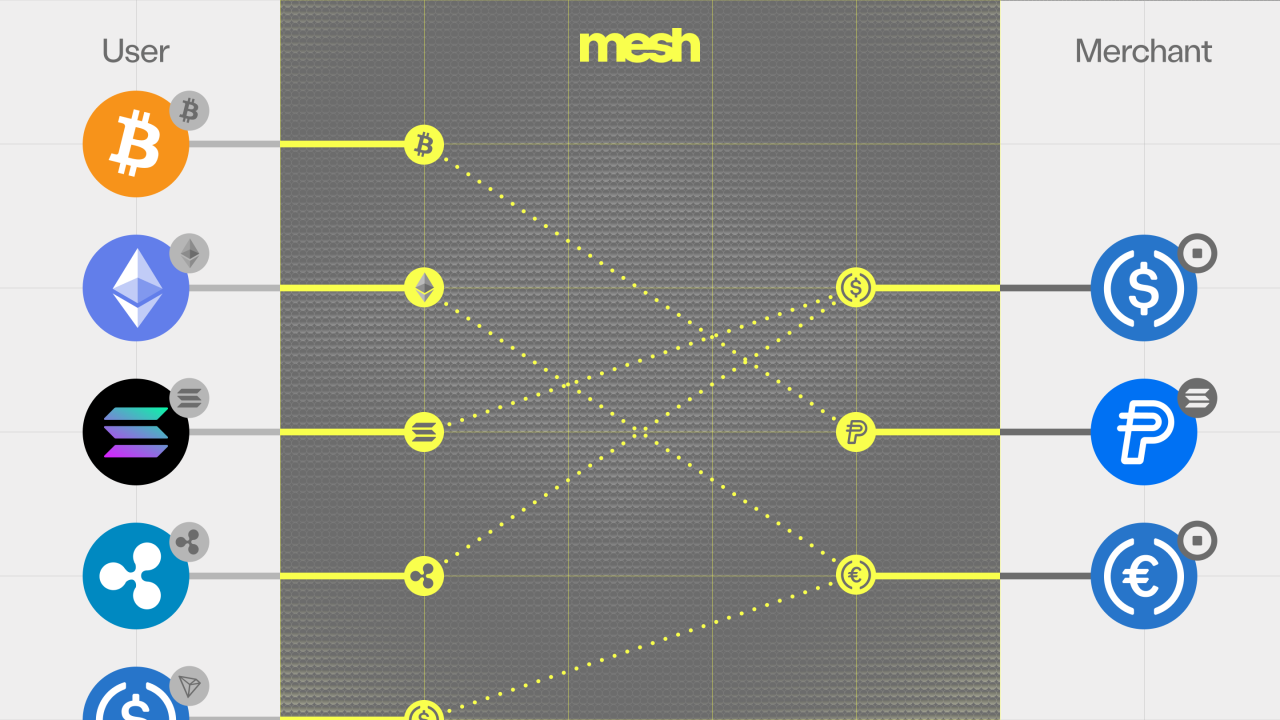
At Mesh, we’ve built infrastructure that unifies fragmented parts of the crypto ecosystem and offers a single integration point for any platform. Designed with security at its core, it’s built to handle the scale and complexity agentic payments will demand. As crypto becomes more fragmented and AI agents multiply across protocols, only deeply interoperable systems will be able to keep up. I’m biased, but I believe any platform entering agentic commerce will need infrastructure like Mesh behind it.
Ultimately, agentic payments cannot thrive on legacy rails. They need an open, composable financial layer that supports real-time transactions and empowers agents to act autonomously. That layer is crypto. To unlock their full potential, agentic payments must be built on crypto rails.
Want more like this? Subscribe to Mesh Weekly.


.png)
.png)

.png)



.png)


.png)




.png)




.png)







%20(1).png)























.png)
.png)
.png)
.png)
.png)
.png)
.png)
.png)

.png)