.svg)

.svg)

May 20, 2026
SmartFunding: How Mesh Made "Pay With Crypto" Actually Work
For most of crypto's history, the phrase "pay with crypto" has been quietly misleading. What it actually meant for the user was: hold the exact asset the merchant accepts, on the exact network the merchant accepts it, in the exact amount required, with enough left over to cover gas in a third token. Miss any of those conditions and the transaction failed — usually at the worst possible moment, in front of a customer who'd already decided to buy.
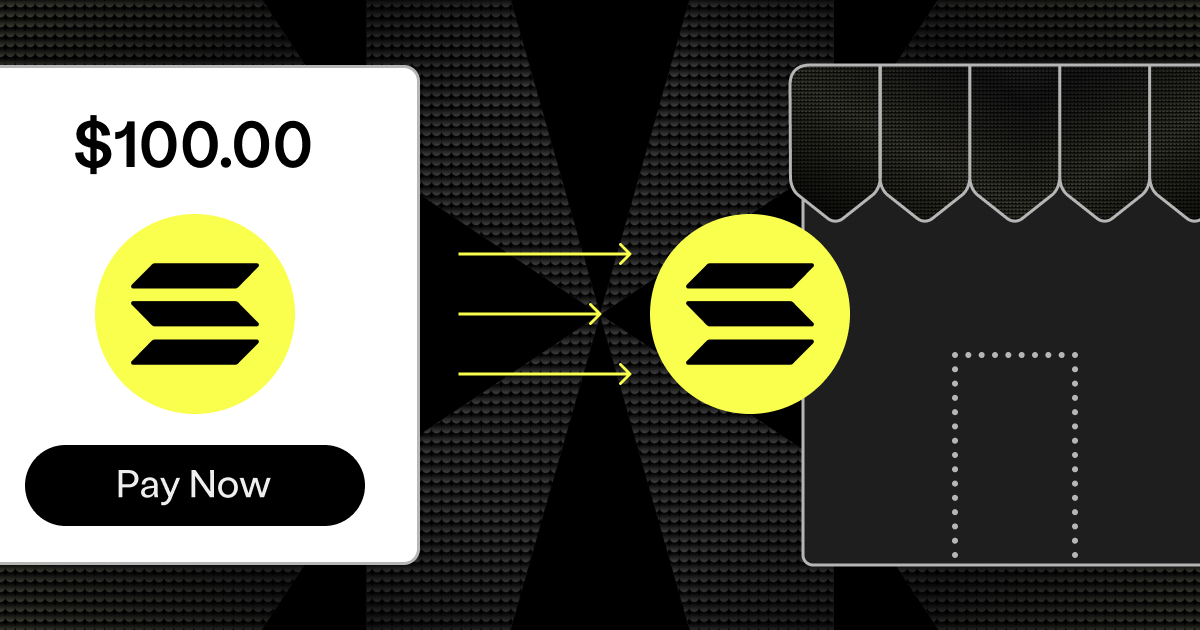
Mesh's SmartFunding capability ends that experience. It's the orchestration layer that lets a customer pay with whatever they hold while the merchant receives exactly what they asked for, instantly, in a stablecoin or local currency. This article explains how SmartFunding works, why Mesh's payment solution is structurally different from the gateways and point solutions that came before it, and what it does to the metrics that actually matter — deposit success rates, average order value, and merchant volatility exposure.
The problem SmartFunding solves: asset mismatch
The structural problem in crypto payments isn't the blockchain. It's the gap between what users hold and what merchants want.
Users hold a portfolio. The median crypto holder has balances across multiple wallets and exchanges, across multiple chains, in multiple tokens — some volatile, some stable, some on the wrong network for whatever they're trying to do right now. Merchants want one thing: a specific stablecoin or local currency, settled on their preferred rail.
Conventional crypto gateways handle this gap by pushing the work onto the user. Before paying, the user has to convert into the right token, bridge to the right chain, fund gas separately, and copy a 42-character address — usually across three different apps. Each step is a place to drop off. Most users do.
The result is the gap that early Bitcoin payment gateways famously couldn't close. Even with high-profile launches and full executive backing, retailers consistently reported crypto sales at fractions of a percent of total volume. The blockchain worked. The architecture around it didn't.
What SmartFunding actually does
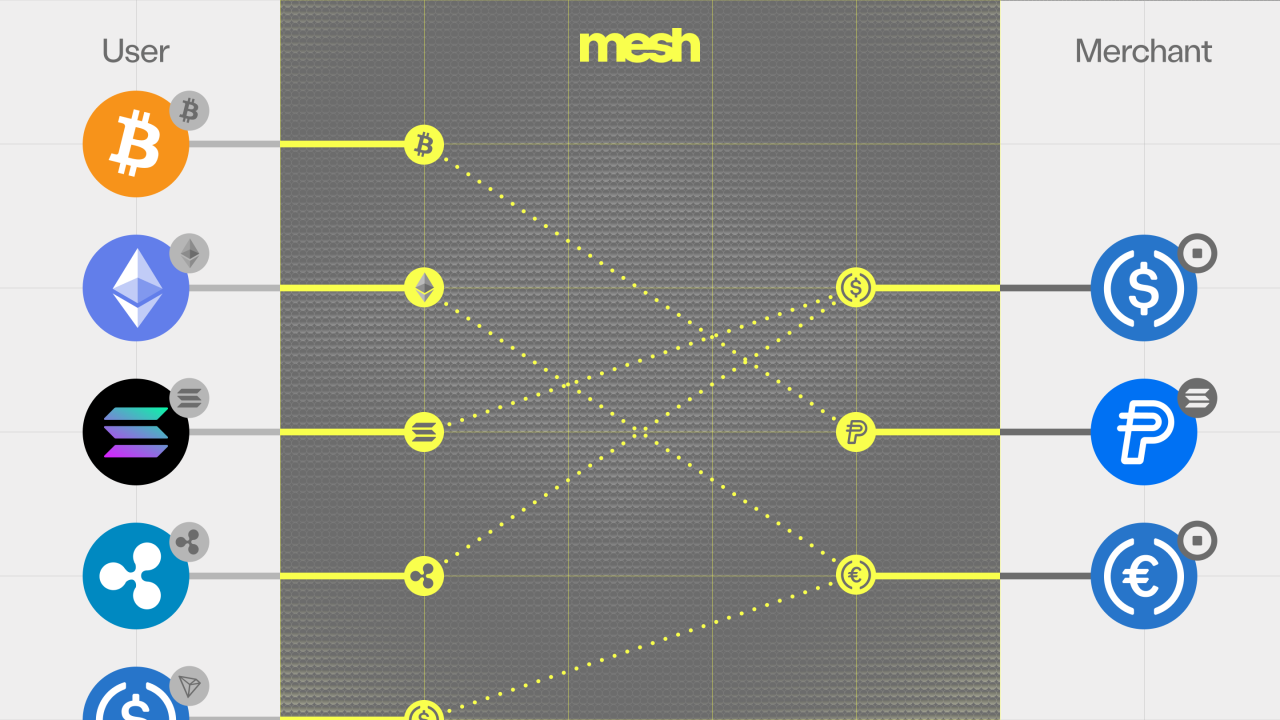
SmartFunding is intelligent transfer routing. When a customer initiates a payment or a deposit, the system looks at the customer's connected account — their balances, the assets they hold, the rails available — and figures out the cheapest, fastest, most reliable path from what they hold to what the merchant needs.
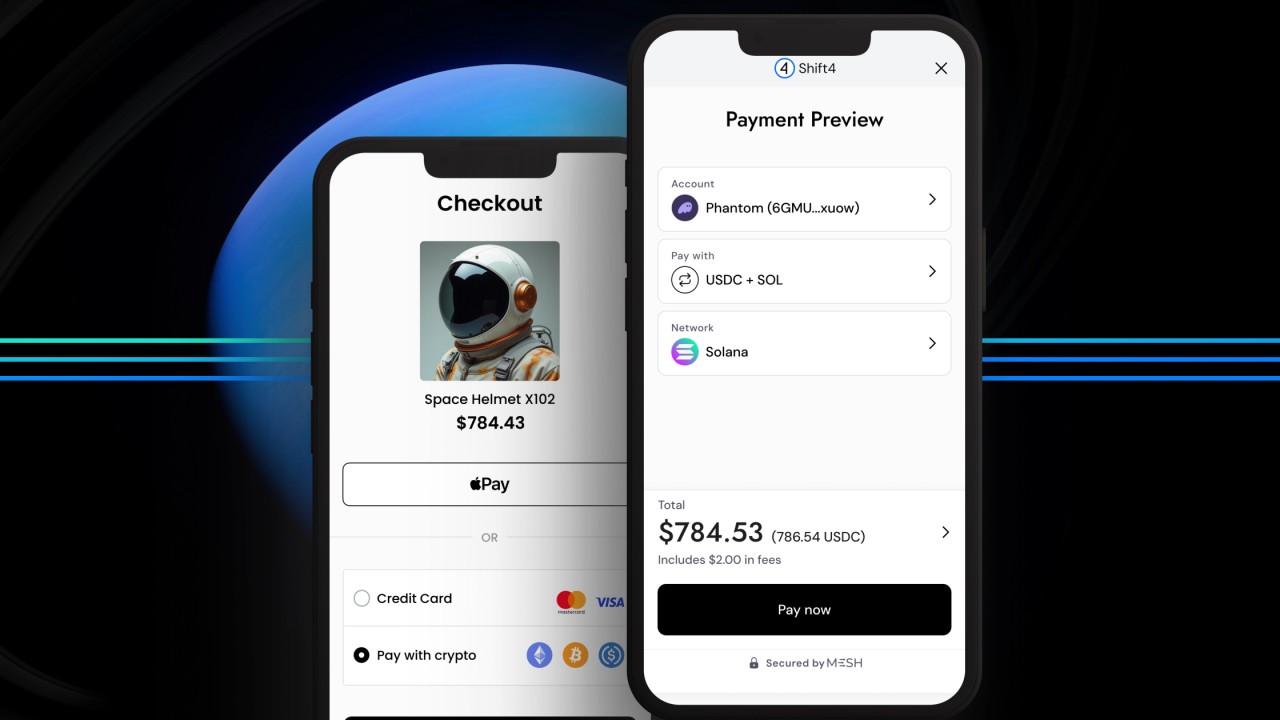
The customer experience is one tap. Behind it, SmartFunding can combine up to five funding sources within the connected account in a single transaction — pulling from multiple held tokens (e.g. an ETH balance and a PYUSD balance both converting into USDC), available cash balance to purchase the needed asset, and any linked payment method to fill a shortfall. The user holds whatever they hold; SmartFunding assembles the transaction.
Whatever combination the routing picks, the merchant receives a single settled payment in their preferred currency: a stablecoin or local fiat. The user never sees the routing, never picks a network, and never holds a wrong-token-on-wrong-chain mismatch.
Why Mesh's payment solution is structurally different
The category of "smart routing" is older than crypto payments, but most implementations choose the route on one dimension — usually cost. SmartFunding picks across three dimensions simultaneously.
1. It optimizes across cost, speed, and reliability
The algorithm doesn't just find the cheapest path. It evaluates routes by speed (network finality time, conversion latency), cost (gas, swap fees, FX spread), and reliability — meaning the route that's most likely to complete given current network conditions, available liquidity, and supported pairs. The customer gets the route most likely to land, not just the one with the lowest sticker price.
2. It connects to authenticated accounts, not raw addresses
This is the architectural choice that makes the experience possible. Most crypto gateways generate a deposit address and hope the customer copies it correctly. Address poisoning, copy-paste errors, and network mismatches have produced confirmed losses of $83.8M across 270 million attempted attacks targeting 17 million potential victims, per Carnegie Mellon CyLab research. In December 2025, a single trader lost $50M to a spoofed address that matched only the first three and last four characters of the real one.
SmartFunding doesn't use that model. The customer logs into their wallet or exchange with their familiar credentials, sees their verified balances, and confirms the transfer from inside the authenticated session. There's no address to copy and no network to pick. The transaction executes programmatically.
3. It handles asset conversion at the point of transaction
The user's volatile asset becomes the merchant's stable asset at the moment of transaction. The merchant never takes custody of Bitcoin, Ethereum, or any other volatile token; they receive the stablecoin or local fiat they configured as their settlement currency the moment the payment clears. The volatility window — the period between transaction initiation and settlement during which the merchant's books are exposed to price movement — is functionally eliminated.
4. It works across the whole network
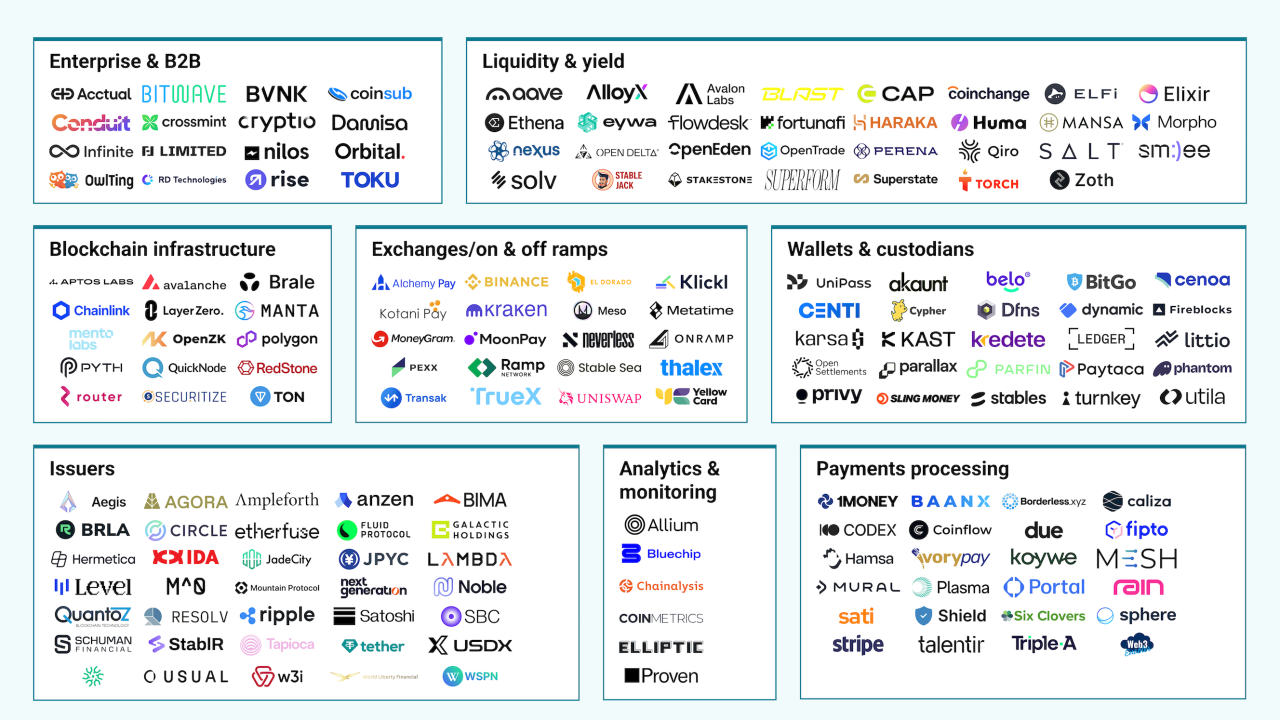
SmartFunding sits above the underlying chains and venues. The Mesh network is asset-agnostic and rail-agnostic by design — connecting to the assets enterprises and customers actually transact in (the major volatile assets including BTC, ETH, and SOL, and the full set of major stablecoins including USDC, PYUSD, USDT, and RLUSD) across the major networks enterprises actually settle on (Ethereum, Solana, Polygon, Base, Stellar, Tron, Tempo, and others). As the network adds new chains, new stablecoins, and new exchanges, SmartFunding gains those routing options without the merchant changing a line of code.
The volatility problem, and how SmartFunding actually removes it
Volatility risk for merchants accepting crypto comes from two places: holding the asset on the balance sheet, and the lag between transaction and settlement.
SmartFunding closes both gaps in the same flow:
- No volatile balance sheet exposure. The merchant configures their settlement currency once — a major stablecoin or local fiat. Every transaction settles in that currency, regardless of what the user paid with. No accounting workflow for converting balances at end of day. No treasury policy carve-out for unhedged crypto exposure.
- No settlement lag exposure. Conversion happens at the moment of transaction, not in a batch at the end of the day. The price the merchant sees in their dashboard is the price they receive.
This is why SmartFunding makes crypto acceptance viable for businesses that have specifically refused to touch crypto on volatility grounds — luxury merchants taking high-value transactions, travel platforms processing international bookings, prediction markets settling outcomes, and global PSPs like Shift4 enabling crypto acceptance for their merchant base.
The numbers SmartFunding has produced
The mechanism only matters if the metrics improve. The validated proof points:
- Kalshi, the first federally regulated prediction market, saw 138% deposit growth after deploying Mesh's infrastructure, with roughly 1 in 4 deposits routed through SmartFunding and ~88% of bridging transactions originating from non-native stablecoins — a direct measure of how often the customer's asset doesn't match the platform's native rail.
- Mesh's own $82M Series B in March 2025 was settled largely in PYUSD on Mesh's rails, with PayPal Ventures' earlier strategic investment also partially settled in stablecoins — institutional-scale proof that the same infrastructure powering merchant payments handles enterprise-grade transfers.
- The Payment Technology Award at the Global FinTech Awards in October 2025 — recognition specifically for the infrastructure approach behind SmartFunding, not the application layer.
Where SmartFunding fits in the broader Mesh network
SmartFunding is one capability, but it's the orchestration engine that ties the rest of the Mesh network together:
- Connectivity — 300+ wallets, exchanges, and platforms; 120+ tokens across 24+ networks — gives SmartFunding the funding sources to route across.
- Verification — wallet ownership verification, signed-message attestation, KYC identity matching — gives SmartFunding the compliance and trust signals to route through legitimate counterparties only.
- Settlement — major stablecoins (USDC, PYUSD, USDT, RLUSD, and others) and local fiat, across the networks enterprises settle on — gives SmartFunding the destinations to land in.
When customers describe Mesh as "the network of networks" for crypto payments, SmartFunding is the part that actually makes the network function as one network.
Frequently asked questions
What is SmartFunding in one sentence?
SmartFunding is Mesh's payment orchestration capability that lets a customer pay with any crypto they hold while the merchant receives instant settlement in their preferred stablecoin or local currency.
How does SmartFunding remove volatility risk for merchants?
The user's volatile asset converts to the merchant's chosen stable asset or local fiat at the moment of transaction. The merchant never holds the underlying volatile token, and there's no settlement lag during which prices can move.
Can SmartFunding combine multiple funding sources?
Yes. Within a connected account, SmartFunding can combine up to five funding sources — including multiple held tokens, available cash balance, and linked payment methods — into a single transaction the customer experiences as one tap. For example, an ETH balance and a PYUSD balance can both convert into USDC inside the same payment.
Which assets and chains does SmartFunding support?
SmartFunding works across the assets and networks connected to the Mesh network — 120+ tokens across 24+ networks, including the major volatile assets (BTC, ETH, SOL) and the major stablecoins (USDC, PYUSD, USDT, RLUSD), on networks including Ethereum, Solana, Polygon, Base, Stellar, Tron, and Tempo.
How does SmartFunding compare to a typical crypto payment solution?
A conventional solution requires the customer to send a specific token on a specific chain to a specific address. SmartFunding orchestrates within the customer's account, picks the route, handles the conversion, and delivers the merchant a single settled payment — turning a multi-step user flow into a single tap.
Where can I see SmartFunding in production?
SmartFunding powers crypto payments for PayPal's Pay with Crypto service and Shift4's global merchant base, among other enterprise deployments.
What's next
SmartFunding is one capability inside Mesh's broader payments infrastructure — built for enterprise scale, with the connectivity, settlement, and verification to match.
Building or evaluating? Read the developer docs →
Ready to talk? Get in touch with our team →


.png)
.png)

.png)


.png)


.png)




.png)



.png)







%20(1).png)






















.png)
.png)
.png)
.png)
.png)
.png)
.png)
.png)

.png)