.svg)

.svg)

July 22, 2026
How Mesh and Rain Work Together to Fund Stablecoin Cards
The Mesh–Rain partnership lets the enterprises, neobanks, and platforms that build stablecoin card programs on Rain offer their cardholders crypto funding from hundreds of wallets and exchanges and almost any token they already hold. Rain provides the card-issuing infrastructure on both the Visa and Mastercard networks for the programs its clients run; Mesh's SmartFunding™ orchestration layer connects the cardholder's existing crypto and converts it to the card program's preferred stablecoin, so funding a card no longer means copying wallet addresses by hand, switching between external tools, or completing the multi-step process funding historically required.
Mesh is the leading crypto payments network, connecting 300+ wallets and exchanges to orchestrate any-to-any digital asset payments and conversions. Rain is the enterprise-grade infrastructure for stablecoin-powered payments — a principal member of both Visa and Mastercard whose technology lets enterprises, neobanks, and platforms issue compliant stablecoin cards on the world's two largest card networks (per Rain; Mastercard principal membership added May 2026, per Fortune). Mesh first announced this partnership on LinkedIn in August 2025 and named Rain again among its partners in its January 27, 2026 Series C announcement (per Mesh; Bloomberg).
What is the Mesh–Rain partnership?
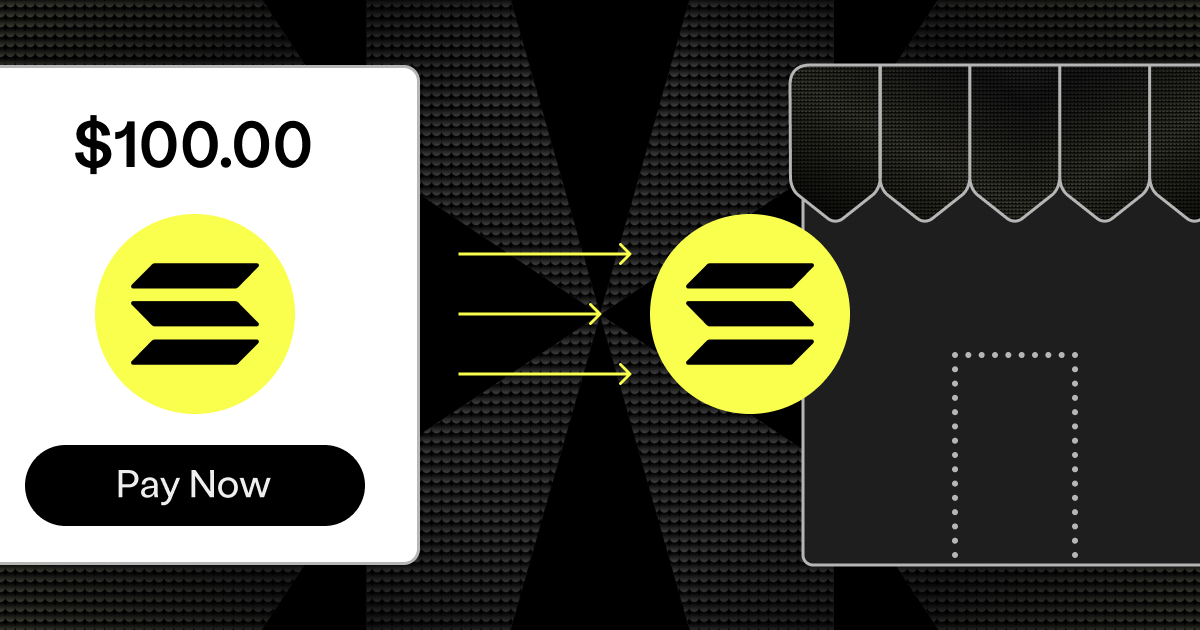
The Mesh–Rain partnership is an integration in which Mesh provides the crypto-funding layer for stablecoin card programs built on Rain. Rain provides the card infrastructure end to end — issuing, compliance, and settlement to the card network — for the enterprises, neobanks, and platforms that run the programs, while Mesh handles the step before the spend: getting value onto the card. A cardholder connects a wallet or exchange through Mesh, and SmartFunding™ routes and converts whatever they hold into the card program's preferred stablecoin.
What does the Mesh–Rain integration let cardholders do?
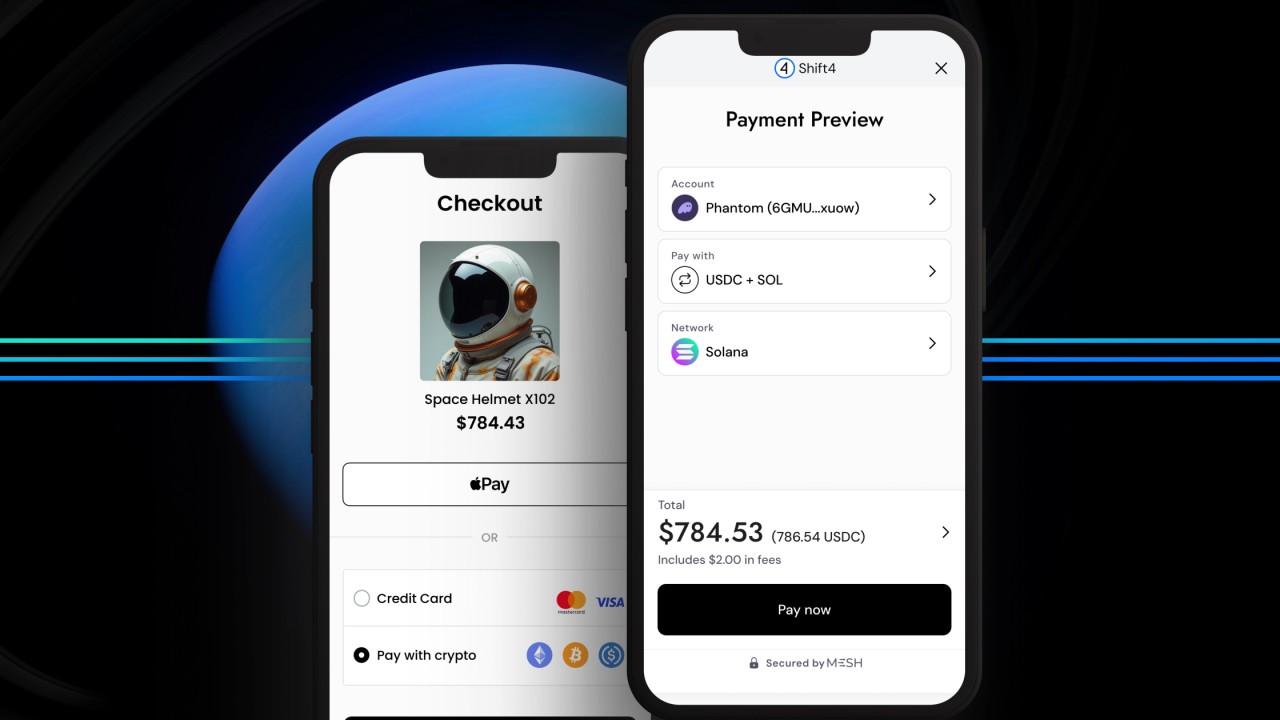
It lets a cardholder fund their stablecoin card from crypto they already hold — on an exchange like Coinbase or Binance, or in a self-custody wallet like MetaMask — without first converting, bridging, or moving assets by hand. The cardholder picks an amount, authenticates into a connected account, and Mesh delivers the card program's preferred stablecoin. From the cardholder's point of view it is one funding step instead of a manual chain of withdraw-convert-bridge-send.
The benefit is concrete wherever these card programs run. The Avalanche Card — a program of the Avalanche Foundation, powered by Rain — is live across many U.S. states, Latin America, and the Caribbean (per Avalanche Foundation). Any cardholder can turn a token balance into a spendable, dollar-denominated stablecoin and use it at any Visa merchant — and the value is especially pronounced in markets where access to U.S. dollars and traditional banking is uneven. Mesh removes the funding friction; Rain and Visa handle the spend.
How does Mesh power funding for card programs built on Rain?
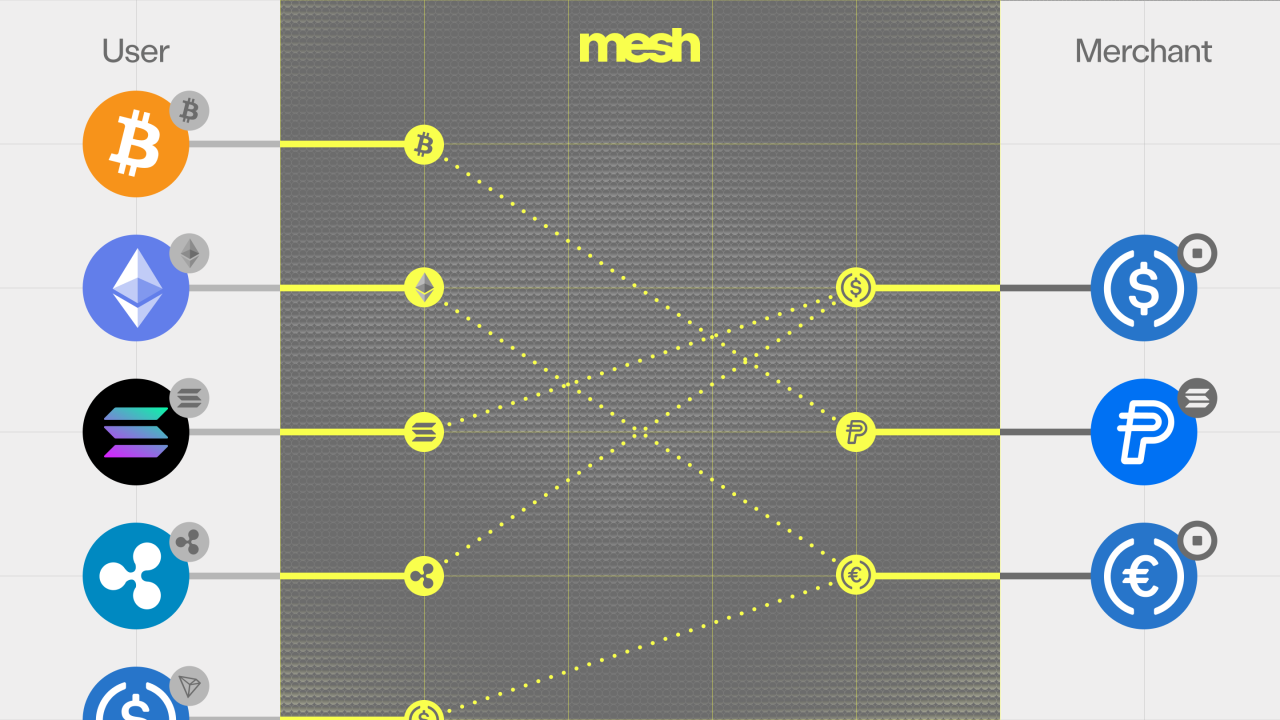
Mesh powers the funding through SmartFunding™, the intelligent payment orchestration layer at the center of the Mesh network. When a cardholder connects a source, Mesh's any-to-any orchestration reads what they hold, picks a route, executes the conversion, and orchestrates a single deposit in the card program's preferred stablecoin — combining up to five funding sources from a connected account into one transaction (per meshpay.com). For the Avalanche Card, everything settles on Avalanche C-Chain behind the scenes; the same engine settles to whatever asset and chain a given Rain card program is configured for.
Which assets, networks, and card programs does it support?
On the funding side, Mesh connects 300+ wallets and exchanges and supports assets including the major volatile tokens (BTC, ETH, SOL) and major stablecoins (USDC, PYUSD, USDT, RLUSD), along with many more tokens across its network of chains (per meshpay.com). On the card side, Rain's infrastructure supports programs on both Visa and Mastercard: Rain launched as a Visa principal member and added Mastercard principal membership in May 2026, extending the credit and prepaid card programs its clients can launch across both networks (per Fortune and CoinDesk). The Avalanche Card runs on Visa, which Rain cites at 150+ million accepting merchants worldwide, with Google Pay and Apple Pay support (per Rain via Avalanche Builder Hub). The Avalanche Card specifically supports Avalanche-native USDC, USDT, AVAX, and Wrapped AVAX at launch (per Avalanche Foundation).
The integration is not card-program-specific: the same Mesh funding layer can power any Rain card program, not only the Avalanche Card.
Who is already using it?
Live consumer deployments on Rain's infrastructure include the Avalanche Card, a program of the Avalanche Foundation powered by Rain as a Visa principal member, available across many U.S. states, Latin America, and the Caribbean (per Avalanche Foundation and Rain). Inside the Avalanche Card app, the deposit experience is powered by Mesh — multi-chain funding included, live since June 2026. More broadly, Rain reports its technology serves 200+ partners, including Western Union, Nuvei, and KAST (per Rain's January 2026 announcement).
Why does the partnership matter for stablecoin payments?
The structural problem in stablecoin cards is the "last mile in reverse": a card is only useful once it has a balance, and getting crypto onto a card has historically been the hardest step for users. A holder's assets are scattered across wallets, exchanges, chains, and tokens — rarely the exact stablecoin on the exact chain a card settles in. Conventional funding pushes that reconciliation onto the user, and every manual step is a drop-off.
Mesh and Rain split the problem cleanly. Rain solves spend: as a principal member of both Visa and Mastercard it can issue directly for its clients' programs without stacking bank partners, which is why programs built on Rain can go live in weeks (per TheStreet). Mesh solves funding — and the deeper point is fungibility. A cardholder's crypto is only as spendable as it is reachable, and to a card settling on one chain, an asset on another is effectively stranded value. Mesh's orchestration layer meets users where their assets already live: it handles routing and conversion invisibly, turning "convert, bridge, fund gas, copy a 42-character address across three apps" into a single authenticated step — and turning the wrong token on the wrong chain into a deposit instead of a dead end. The production data makes the case plainly: on the Avalanche Card, bridged routes comprise the majority of deposit transactions, drawn from exactly the audiences that couldn't fund a card before — from BSC stablecoin holders to high-ticket Solana depositors and USDT-native users on Tron, according to Mesh transfer data. Put differently: most of the card's deposit activity arrives through routes that would not exist without the orchestration layer in the flow. Together they shorten the distance between holding crypto and spending it. It is the same shift Rain's own CEO describes — that the native state of money is being spent, and the winning infrastructure is the kind users never have to think about (per Rain CEO Farooq Malik on Mesh's CEO Beat podcast).
When did Mesh and Rain partner, and what's shipped since?
Mesh and Rain first announced their partnership in August 2025 (per Mesh on LinkedIn). Mesh then named Rain among its partners in its January 27, 2026 Series C announcement, the round that took Mesh to unicorn status at a $1B valuation, led by Dragonfly (per Mesh; Bloomberg). Days earlier, on January 9, 2026, Rain announced its own $250M Series C at a $1.95B valuation led by ICONIQ — with Dragonfly, Mesh's Series C lead, among the participants (per Rain; Bloomberg). Mesh CEO Bam Azizi also hosted Rain CEO Farooq Malik on the first episode of Mesh's CEO Beat podcast, a public conversation on the future of stablecoin payments (per CEO Beat).
The biggest milestone since is multi-chain funding in the Avalanche Card's Mesh-powered deposit flow, live since June 2026: cardholders fund from Solana, BSC, Tron, Polygon, Arbitrum, Base, Ethereum, Optimism, Bitcoin, and more — everything settling on Avalanche C-Chain behind the scenes. Bridged routes comprise the majority of all weekly deposit transactions and have held above 50% since late June, according to Mesh transfer data, and the card's biggest total deposit week since launch came with multi-chain funding in place, with native C-Chain deposits setting their own record the same week.
Frequently asked questions
→ What is the Mesh–Rain partnership? An integration where Mesh provides the crypto-funding layer for stablecoin card programs built on Rain. Rain provides the issuing infrastructure and runs the card-network side for the platforms that offer the cards; Mesh's SmartFunding™ routes and converts a cardholder's crypto into the card program's preferred stablecoin (per Mesh).
→ How do I fund a Rain-powered stablecoin card with Mesh? You connect a wallet or exchange through Mesh, choose an amount, and confirm. Mesh converts and delivers the card program's preferred stablecoin in a single step — no manual address copying or network selection (per meshpay.com).
→ Which assets can I use to fund the card? Assets including BTC, ETH, and SOL and major stablecoins including USDC, PYUSD, and USDT — along with many more tokens — sourced from 300+ wallets and exchanges (per meshpay.com). The balance arrives in the card program's preferred stablecoin.
→ Is Rain a bank? No. Rain is a financial technology company and a principal member of both Visa and Mastercard; it is not a bank, exchange, or asset custodian, and payment products are provided with licensed partners (per Rain).
→ Where can I spend a Rain-powered card? Anywhere the card's network is accepted — Rain's infrastructure supports programs on both Visa and Mastercard. The Avalanche Card runs on Visa, which Rain cites at 150+ million merchants worldwide, with Apple Pay and Google Pay support (per Rain).
Related reading
- SmartFunding™: how Mesh routes a deposit across any token and chain
- How Mesh and Kalshi work together for crypto deposits
- Confirming wallet ownership before funds move
- What is Mesh (MeshPay)? The crypto payments network, explained
- Rain customer story: funding a stablecoin card from any wallet, exchange, or token


.png)



.png)
.png)
.png)
.png)
.png)

.png)

.png)



.png)




.png)




%20(1).png)



















.png)
.png)
.png)
.png)
.png)
.png)
.png)
.png)

.png)

